Paper bag machine

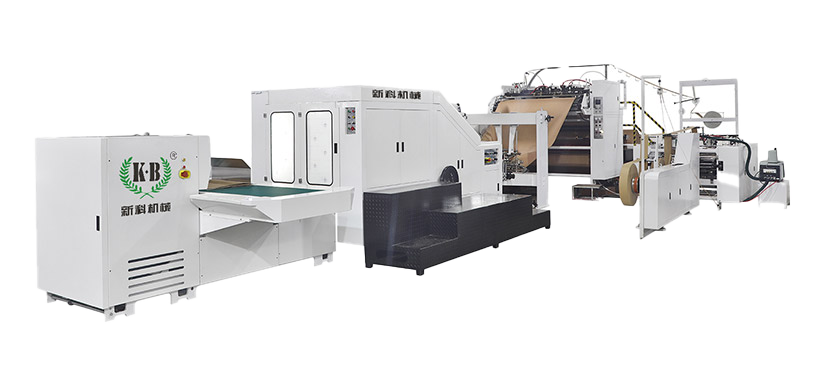
Fully automatic paper bag machine, used to produce portable paper bags with handles. This machine is particularly suitable for mass production of shopping bags in the food and clothing industries.

This machine uses an imported high-speed motion controller (CPU) to control the operation of the servo through a high-speed bus to ensure stable motion and smooth motion curves.

It is the first choice for fully automatic portable square bottom paper bag equipment for printing and packaging manufacturers.

Paper bag machine
←
→
pro-list-5.png
Adjustable Roll Feeding Square Bottom + D Cut Paper Bag Making Machine
Model:XKFD-220D

XKFD-220D Adjustable Roll Feeding Square Bottom + D Cut Paper Bag Making Machine is a paper bag production line that can automatically feed, fold, and bottom form, and can produce different types of paper bags according to specifications. It is widely used in retail, food, printing and packaging, and gifts and cosmetics industries.

Bag Length: 150-320mm

Bag Width: 80-220mm

Paper Thickness : 50-130 g/㎡

Bag Making Speed : 30-200pcs/min

pro-list-5.png
2 Colors Printing Square Bottom Paper Bag Machine
Model:XKFDP-220W

XKFDP-220W 2 Colors Printing Square Bottom Paper Bag adopts fully automatic production and has the ability to print in two colors. The bottom of the paper bag is designed to be square, which enhances the load-bearing capacity and stability of the paper bag. The equipment is equipped with advanced control systems and detection devices to ensure precise control of paper transmission, positioning, printing and other links.

Bag Length: 150-320mm

Bag Width: 80-220mm

Paper Thickness : 50-130 g/㎡

Bag Making Speed : 30-200 pcs/min

pro-list-5.png
Web fed 2 color printing square bottom paper bag machine
Model:XKFD220

XKFD220 Web fed 2 color printing square bottom paper bag machine is highly adjustable and can adjust the paper according to production needs. It is equipped with advanced two-color printing system, which can print two different colors of patterns, texts or trademarks on the surface of paper bags. The highly automated production is widely used in the packaging industry.

Bag Length: 150-320mm

Bag Width: 80-220mm

Paper Thickness : 50-130 g/㎡

Bag Making Speed : 30-200 pcs/min

Our Competitiveness
Xinke's square bottom paper bag machine has the following unique advantages in terms of sustainability, adaptability to a variety of paper materials and quality.
pro-list-6.jpg
Sustainability
Our paper sack machine is designed with a strong commitment to sustainability, utilizing environmentally friendly materials like recyclable cardboard and eco-friendly kraft paper.
By focusing on degradable paper options, our machine helps reduce the negative environmental impact and supports a circular economy.
pro-list-7.jpg
Adapt to multi-material paper
The paper sack machine is highly adaptable, capable of processing various types and thicknesses of paper materials. Whether you're using standard kraft paper, white cardboard, or specially coated paper, the machine ensures consistent quality and stability, producing durable paper sacks suitable for a wide range of applications.
pro-list-8.jpg
Technological innovation and automation
Incorporating technological innovation and automation, the paper sack machine features advanced computer control systems and automated equipment. This not only enhances the efficiency, stability, and reliability of the production process, but also helps minimize resource wastage and labor costs, making it a cost-effective and sustainable choice for modern manufacturing.
FAQ
When can I get the price?

Usually we quote within 24 hours after we get your inquiry.

What is the price of shipping?

Depending upon the port of delivery, prices varies.

How long can we get the goods?

For standard machine, we usually delivery in three weeks. Customized machine delivery in 30-60 days.

Guaranteed Customer Satisfaction Case
You may be interested in learning about the Xinke Aftermarket Case Studies to learn how we successfully maintain machinery and provide customer support.
solution-4.png
Latest News & Events
We are always happy to provide you with any assistance you may need with your purchase of a Xinke machine, and we are always where you need us, ready to serve you.
Why 2026 Paper Bag Machine Buyers Are Prioritizing Recipe Management and Fault Diagnostics Over Top Speed
2026 / 11 / 18

A paper bag machine running at 250 bags per minute sounds like a productive asset—until it stops for 40 minutes to clear a glue nozzle, then another hour to switch from a flat-handle to a twisted-rope format. The output that looked impressive on the spec sheet never reaches the packing station.

That gap between rated speed and usable output is where the 2026 buying conversation has moved. Labor shortages, shorter order runs, and rising pressure to hold margin on mixed-SKU schedules are pushing procurement teams to look past the top-end number and ask a different set of questions. The paper bag machine that wins the order is no longer the fastest one on the floor. It is the one that changes over without drama and tells the operator what went wrong before the line goes down.


What Made Speed the Default Metric—and Why That Is Shifting 

For years, the paper bag machine market sold on one number. A higher bags-per-minute figure was easy to compare, easy to put in a brochure, and easy to justify in a capital request. The logic held as long as orders were long and stable: one bag size, one paper grade, one handle type, week after week.

That production profile is becoming less common. Brand proliferation and shorter production runs are raising the value of modular lines, digital controls, and automated setup. A converter who once ran a single grocery bag format for a season now manages a schedule where bag width, gusset depth, paper GSM, and handle style can all change inside a single shift. Under that order mix, a machine optimized only for peak speed becomes a bottleneck at every transition.

There is a second force at work. Experienced operators are harder to find and keep. Higher labor costs and shortages of skilled staff are making automated setup, recipe management, and fault diagnostics practical requirements rather than premium add-ons. When the person who “knows the machine by feel” is not on the floor, the control system has to carry more of the adjustment and diagnosis burden.

Neither of these points makes speed irrelevant. It makes speed conditional: a fast paper bag machine only earns its rating when it can stay in production across the formats a factory actually sells.


The Hidden Cost of a Fast Machine That Stops Often

The case for recipe management and fault diagnostics becomes clearer when downtime is costed properly. A machine rated at 120 bags per minute loses 7,200 bags of output for every hour it sits idle—before counting idle labor or downstream schedule disruption. Those hours accumulate from sources that are predictable and repeatable, not random.

Glue system failures rank as the highest-priority cause of unplanned downtime in paper bag production. Overheated adhesive clogs nozzles, produces uneven application, and forces cleaning stops that can eat 40 minutes at a time. Changeover delays follow closely: a format switch that takes 30–45 minutes on a conventional setup, repeated several times a week, quietly removes productive hours from the month.

The distinction that matters for buyers is between downtime categories. A glue blockage and a size changeover may each cost 40 minutes, but the fixes are completely different—one points to temperature control and nozzle maintenance, the other to recipe storage and servo repositioning. A paper bag machine without clear diagnostic separation leaves the operator guessing which loss category they are dealing with, and guessing is expensive.

This is where a paper bag machine with built-in fault monitoring changes the economics. When the control system identifies the fault location and the loss category, recovery stops depending on operator intuition. The same logic applies to changeover: recipe recall turns a multi-station manual adjustment into a stored parameter set the machine can repeat.

What Recipe Management Actually Changes on the Floor

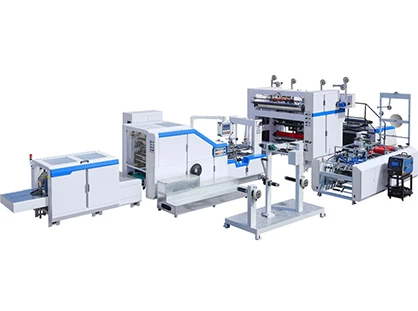
Recipe management is not a marketing label for “a touchscreen.” It is a control architecture decision that determines how much of a changeover depends on human memory.

From operator-dependent adjustment to stored parameters

On a machine without recipe storage, every size change is a sequence of manual inputs: feed timing, sealing temperature, bottom-fold pressure, ejection timing, glue volume. The values live in a notebook, a laminated card, or the operator's head. If the operator is new, the values are learned by trial and error, and the scrap rate during ramp-up reflects that learning curve.

A recipe-managed paper bag machine stores the approved parameter set for each bag specification. The operator recalls the recipe, confirms the physical change parts, and starts. Modern intelligent machines with recipe storage and quick-change systems can reduce changeover to 5–10 minutes, compared with 30–60 minutes on basic lines. The machine is not necessarily running faster at peak. It is spending more of the shift producing.

The labor math behind the control decision 

The labor case is straightforward. Fully automatic machines typically save 2–3 operators per shift compared with semi-automatic setups. At annual labor costs of $25,000–40,000 per operator, that translates to $50,000–120,000 in annual savings before any speed difference is counted. A machine that a new operator can set up from a stored recipe extends that advantage into the changeover window, where semi-automatic lines still depend on experienced hands.

For a converter weighing paper bag machine price against long-term cost, the relevant comparison is not purchase price versus purchase price. It is the 5-year total cost of ownership: energy, labor, glue, spare parts, waste, and downtime loss all sit in the model alongside the invoice. Recipe management and diagnostics move several of those lines in the right direction at once.


Where Fault Diagnostics Fits Into the Buying Decision

Fault diagnostics sits on a spectrum, and buyers should know which end of it a machine occupies before comparing quotations.

At the basic end, the machine stops and displays an alarm code. The operator consults a manual or calls a technician. At the more integrated end, the system continuously monitors paper alignment, temperature, glue condition, and drive behavior, then stops the machine with a specific fault location when a parameter drifts outside the acceptable window. The practical difference is the time between “something is wrong” and “here is what to check first.”

Diagnostics as a changeover tool, not just a breakdown tool 

The more underrated role of diagnostics is during setup, not just during failure. A paper bag machine that is switching from one bag size to another is temporarily outside its stable operating window. Tension, registration, and glue patterns are all re-establishing themselves. A diagnostic system that flags misalignment or temperature imbalance during the first few dozen bags of a new recipe prevents a small setup error from turning into a scrap pile or a jam at the bottom-forming station.

This is why recipe management and fault diagnostics belong in the same conversation. Recipes reduce the frequency of adjustment; diagnostics reduce the cost of the adjustments that remain. A machine with one but not the other leaves part of the changeover risk unaddressed.


What to Verify Before You Compare Paper Bag Machine Prices 

The 2026 buyer’s checklist has shifted from “what is the top speed” to “what happens between orders.” A practical verification sequence looks like this:

Ask for changeover time on the bag sizes you actually run, not the easiest format in the catalog. Then ask which parameters the machine stores and which require manual setting. A recipe that covers speed and length but leaves glue temperature and bottom-fold pressure to operator judgment is only a partial recipe.

Run a fault scenario during the factory acceptance test. Introduce a controlled paper misalignment or a temperature drift and observe how the machine responds—does it identify the location, does it suggest a first check, or does it simply stop? The difference between those responses shows up on the production floor months later.

Finally, connect the control features to the total cost model. A paper bag machine with recipe storage and diagnostics may carry a higher upfront figure than a stripped-down alternative, but the 5-year TCO comparison is where the gap usually closes or reverses. The machine that prevents a 40-minute glue stop every week is not more expensive in any meaningful sense. It is cheaper in the categories that repeat.


FAQ 

Does a paper bag machine with recipe management cost significantly more than a basic model?

The upfront difference varies by configuration, but the relevant comparison is 5-year total cost of ownership, not sticker price alone. Recipe storage and diagnostics reduce changeover loss, scrap during ramp-up, and unplanned downtime—three cost lines that compound over the life of the machine.

How much changeover time can recipe management actually save on a paper bag machine?

On machines with quick-change systems and stored recipes, changeover can drop to 5–10 minutes, compared with 30–60 minutes on conventional lines. The saving depends on how many format changes the factory runs per week and whether the recipe covers all critical parameters, including glue and fold pressure.

What is the most common fault a paper bag machine diagnostics system should catch? 

Glue system issues are the highest-priority downtime category in paper bag production—overheated adhesive, clogged nozzles, and uneven application account for frequent stops and cleaning delays. A diagnostics system that monitors glue temperature and nozzle condition addresses the single most repeatable loss source.


Have a specific order mix in mind?

If your schedule includes several bag sizes, handle types, or paper grades per week, the paper bag machine decision is really a changeover and recovery decision. Share your format list, typical run lengths, and paper GSM range, and our team can map the recipe and diagnostic requirements against the configurations that fit your production profile—rather than the speed rating that looks best on a quote.

[Contact Us] — Tell us what you run and how often it changes.

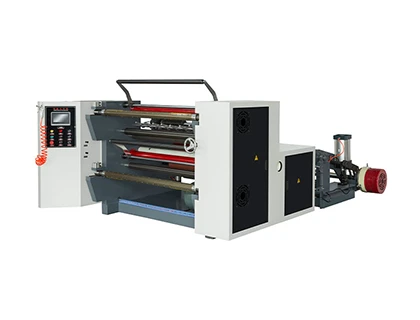
Why Does Your Slitting Machine Vibrate or Get Noisy at Higher Speeds?
2026 / 11 / 10

There is a moment every operator recognizes. The line is running fine at moderate speed, then you push toward rated output, and something changes. A low hum becomes a rattle. The edge starts to wander. The finished roll shows faint chatter marks that were not there twenty minutes earlier. The slitting machine is telling you something—and the message is not always “the bearings are shot.”

High-speed vibration and noise are symptoms with several possible origins. Some live in the cutting zone. Some sit in the rotating components. Some come from the way the machine structure responds to a particular speed. Treating all three as the same problem leads to parts-swapping without a fix. The more useful approach is to match the character of the noise to the mechanism behind it.


Start with the sound, not the parts list

Not all high-speed noise points to the same culprit. A continuous high-frequency whistle tends to follow bearing condition—lubrication breakdown, worn rolling elements, or a damaged cage. A periodic impact that repeats with every revolution usually traces back to the blade or knife shaft: a bent shaft, a loose lock nut, or a gap that opens and closes as the blade rotates. A low-frequency rumble that appears only in a narrow speed band is a different animal altogether—it points toward structural resonance rather than wear.

The practical first step is to note when the noise appears. If it follows speed linearly, the source is likely rotational. If it arrives at a specific RPM and fades once you move past it, resonance deserves a closer look. And if the sound changes when you adjust web tension without touching speed, the slitting machine is coupling tension variation into mechanical vibration rather than generating it independently.


Blade geometry and knife-seat rigidity: the cutting-zone suspects 

The blade is the most loaded component on a high-speed slitting machine. At 500–800 m/min, centrifugal force and cutting resistance act on the edge simultaneously, and small deviations amplify quickly. A side runout that is acceptable at low speed becomes a radial impact at every revolution once the RPM climbs.

Blade gap and overlap sit at the center of this. Too small a gap and the upper and lower edges rub, producing a periodic knock. Too large a gap and the material stretches in the cutting zone and snaps back, setting the blade into lateral oscillation. Excessive overlap drives cutting resistance up and deflects the blade sideways. None of these show up clearly on a spec sheet—they show up as edge burr, wavy trim, and a noise that worsens as speed increases.

The knife seat matters just as much. If the lock nut between the blade and the cutter shaft is not holding torque under continuous high-speed running, the blade micro-moves on the shaft and generates a pattern of chatter that no amount of blade replacement will cure. Low-frequency resonance in the tool holder often traces to insufficient rigidity in the mounting base or fasteners that have lost preload, not to the blade itself.


Rollers, shafts, and the balance question

Rotating components other than the blade deserve the same scrutiny. Unwind and rewind shafts, guide rollers, and nip rollers all carry residual imbalance that becomes more consequential as surface speed rises. A roller that runs acceptably at 200 m/min can introduce visible vibration and web flutter at 600 m/min if its balance grade was never specified for that operating window.

For high-speed slitting and rewinding, the relevant benchmark is dynamic balancing to ISO 1940 G2.5 at the actual working speed, not a low-speed static balance check. Guide rollers and driven rollers on lines running above roughly 600 m/min are commonly balanced to G2.5 to keep web vibration and lateral wandering under control. Without that baseline, vibration can appear as pressure marks, edge quality drift, or tension fluctuation rather than obvious machine shake—which makes it harder to trace back to the roller.

Shaft alignment and bearing condition belong in the same conversation. A misaligned drive shaft or a bearing with increased internal clearance will produce vibration that reads as “roller imbalance” until the shaft and bearing are checked separately. A dial indicator on radial and axial runout is a faster diagnostic than replacing parts by elimination.


When the machine structure agrees with the speed 

Resonance is the explanation operators reach for last and engineers check first. It occurs when the natural frequency of a machine component—a knife holder, a frame section, a roller assembly—coincides with an excitation frequency generated by rotation or cutting. The symptom is distinctive: severe vibration and noise in a narrow speed band, with quieter running on either side.

The fix is rarely “slow the machine down forever.” Speed modulation during ramp-up can move the line through the resonant band without dwelling in it, and changing acceleration profiles can reduce the time spent in the problematic window. If the resonance is persistent, structural damping or added rigidity at the knife holder or mounting base addresses the natural frequency itself rather than the symptom.


Tension is not separate from vibration

On a tight-line slitting machine, unwind and rewind are coupled through the web. Tension variation travels with the moving web and can excite mechanical vibration in downstream zones even when the rollers and blades are in good condition. A slitting machine that runs quietly at stable tension but becomes noisy when tension control drifts is pointing toward the control loop, not the hardware.

This matters for diagnosis because it changes the order of investigation. If noise appears alongside tension fluctuation, calibrating tension sensors and checking the unwind/rewind tension gradient before disassembling the knife shaft can save hours of unnecessary mechanical work.


What a practical response looks like 

The productive response to high-speed vibration is not a single corrective action. It is a sequence that moves from observation to isolation. Run the machine without material and listen at increasing speed—if the noise persists unloaded, the blade or shaft is the starting point. If it disappears, the cutting zone or material interaction deserves attention. Use a dial indicator to separate shaft runout from blade runout, and a portable vibrometer to distinguish imbalance from bearing fatigue. Then check whether the noise tracks speed linearly or concentrates in a band.

For a slitting machine running at higher speeds day after day, the more durable answer is specification: dynamic balance grades that match the operating window, knife-seat rigidity that does not rely on operator feel, and tension control that holds through acceleration. A slitting machine that is quiet across its full speed range is not a lucky unit. It is one where the cutting zone, the rotating components, and the structure were each designed to avoid fighting one another at the speeds you actually run.


Have a specific speed range where the noise appears?

Tell us where the vibration shows up—the speed band, the material you are running, and whether the noise changes with tension adjustments. We can help you narrow the slitting machine diagnosis to the most likely source and map the fix to your production window rather than a generic checklist.

[Contact Us] — Share your slitting machine model, material, and the speed range where the noise begins.

Inline vs Offline Handle Sticking Machine: Which Setup Matches Your Existing Paper Bag Line?
2026 / 11 / 02

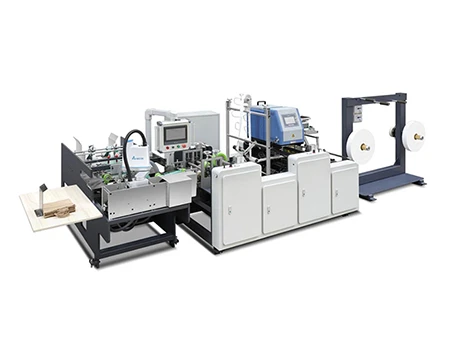
Demand for handled paper bags continues to rise across retail, food service, and gift packaging. If you already run a paper bag machine, the next decision is often not whether to add a handle sticking machine, but how to integrate it. Two setups dominate the conversation: inline and offline. Both can produce flat paper handles or twisted rope handles. The difference lies in how the handle station connects to your bag line—and that difference affects labor, changeover time, glue waste, and how quickly you can respond to mixed orders.

This article breaks down both configurations without pushing one as universally better. The right choice depends on your existing equipment, your typical order sizes, and what happens on your floor when a handle-related bottleneck appears.


What Inline and Offline Setups Actually Mean

An inline setup connects the handle sticking machine directly to your paper bag machine. The bag body and the handle meet in a continuous flow, often with automatic transfer between stations. An offline setup runs the handle sticking machine as a standalone unit. It produces handles—flat paper handles or twisted rope handles—and those handles are later attached to bags in a separate step, either manually or through a secondary pasting station.

The distinction matters because paper bag machines vary widely. A semi-automatic paper bag machine typically requires manual bag feeding and removal, which means the line already has human touchpoints. An automatic paper bag machine runs with fewer interruptions and expects upstream and downstream equipment to match its pace. Your existing line type is the first filter for this decision.


How Inline Configuration Changes Your Production Flow

Inline setups appeal to factories running long, stable orders on automatic bag lines. When the handle sticking machine is synchronized with the bag machine, handles arrive at the pasting position without manual sorting or transport. That reduces handling labor and floor traffic. It also tightens the feedback loop: if handle placement drifts, the bag machine operator sees it immediately rather than discovering it at a separate offline station.

The trade-off is flexibility. An inline setup is built around a specific bag width range and handle type. Switching from flat handles to twisted rope handles, or moving to a significantly different bag size, may require mechanical changeover that affects the entire line. If your order book is dominated by repeat runs of similar bags, that changeover cost is manageable. If you switch bag specs every few days, an inline setup can become a constraint.

Floor space is another factor. Inline configurations often require a longer footprint because the handle station sits in sequence with the bag machine. Retrofitting an inline setup into an existing plant layout is not always straightforward.


Where Offline Setup Wins on Flexibility

Offline handle sticking machines run independently. They can produce handles at their own pace, and those handles can be staged, counted, and delivered to one or more bag lines. For factories running a semi-automatic paper bag machine, this is often the more natural fit. The bag machine produces bag bodies; the handle sticking machine produces and pastes handles in a separate lane or at a separate station. Neither machine waits for the other.

This setup shines when order sizes are smaller and handle types vary. You can run flat handles on one shift and twisted rope handles on the next without reconfiguring the bag machine. You can also allocate handle production across multiple bag lines if demand spikes. The cost appears in material handling: handles must be moved, staged, and fed into the pasting step. That movement adds labor and creates a potential quality check point—or a potential bottleneck if staging is poorly organized.

Glue control deserves attention in offline setups. Because the handle sticking machine runs independently, glue volume and placement can be tuned without affecting bag body production. Automatic counting and gluing functions on modern offline units help maintain consistency, but the operator still needs a clear procedure for checking handle placement tolerance before handles move to the bag line.


Side-by-Side Comparison: Inline vs Offline

Factor Inline Setup Offline Setup
Best fit Automatic bag lines, long runs Semi-automatic lines, mixed orders
Labor for handle handling Lower Higher, unless staged efficiently
Changeover between flat and twisted handles Slower, affects whole line Faster, isolated to handle station
Floor space Longer continuous footprint More flexible placement
Glue and placement control Integrated, immediate feedback Independent, requires staging discipline
Response to urgent order changes Less flexible More flexible
Initial integration complexity Higher Lower

Matching the Setup to Your Existing Paper Bag Line 

Start with your bag machine type. If you run a semi-automatic paper bag machine, an offline handle sticking machine usually matches the existing workflow because the bag line already involves manual loading and unloading. The handle station can run in parallel, and you are not trying to force synchronization between equipment with different operating rhythms. If you run a fully automatic bag line with stable long-run orders, an inline setup can reduce handling and tighten quality feedback.

Next, look at your order mix. Count how many bag sizes and handle types you produced in the last three months. If more than a handful of changeovers happened per week, offline flexibility likely outweighs the handling savings of inline. If you ran the same bag spec for weeks, inline synchronization becomes more attractive.

Finally, walk the floor. Where would handles be staged in an offline setup? Is there clear space between the handle sticking machine and the bag line? In an inline setup, can the bag machine tolerate the additional length and the transfer mechanism without disrupting existing workflow? These physical constraints often decide the question faster than a spec sheet.


Summary 

Inline and offline handle sticking machine setups are not competing technologies. They solve different production problems. Inline favors synchronization, lower handling labor, and immediate quality feedback on stable automatic lines. Offline favors flexibility, independent changeover, and a better fit for semi-automatic bag machines and mixed order books. The right choice starts with your existing paper bag line, then narrows through order mix and floor space.


Have a Specific Bag Line in Mind?

Tell us what bag machine you currently run, your typical bag size range, and whether your orders lean toward long runs or frequent changeovers. Our team will compare inline and offline handle sticking machine configurations against your actual production flow and recommend the setup that fits your line—not the one that looks best on a brochure.

[Contact Us] — Share your bag machine type, handle mix, and daily output target, and we will map them to the right handle sticking machine setup.

GET A QUOTE

Talk to Our Expert

Talk to Our Expert.
Captcha Code
GET IN TOUCH NOW
Captcha Code
We value your privacy
We use cookies to provide you with a better online experience, analyse and measure website usage, and assist in our marketing efforts.
Accept All